








The essential
- Are you managing your Google Ads campaigns yourself?
- Do you adjust your bids manually each week, convinced that this fine control saves you money?
- The reality is often quite different: by 2026, manual bidding for Google Ads has become a luxury that few SMEs can afford — and a budgetary black hole for those who persist in it.
Summary
Are you managing your Google Ads campaigns yourself? Do you adjust your bids manually each week, convinced that this fine control saves you money? The reality is often quite different: by 2026, manual bidding for Google Ads has become a luxury that few SMEs can afford — and a budgetary black hole for those who persist in it.
The problem: Google Ads budgets evaporating without visible return
According to industry data for 2025-2026, nearly 60% of French SMEs managing their Google Ads campaigns in-house waste between 30 and 50% of their advertising budget. The conclusion is relentless: clicks without conversion, bids too high on unprofitable keywords, increased competition for local bids. You spend, Google displays your ads, but the phone doesn't ring any more than before.
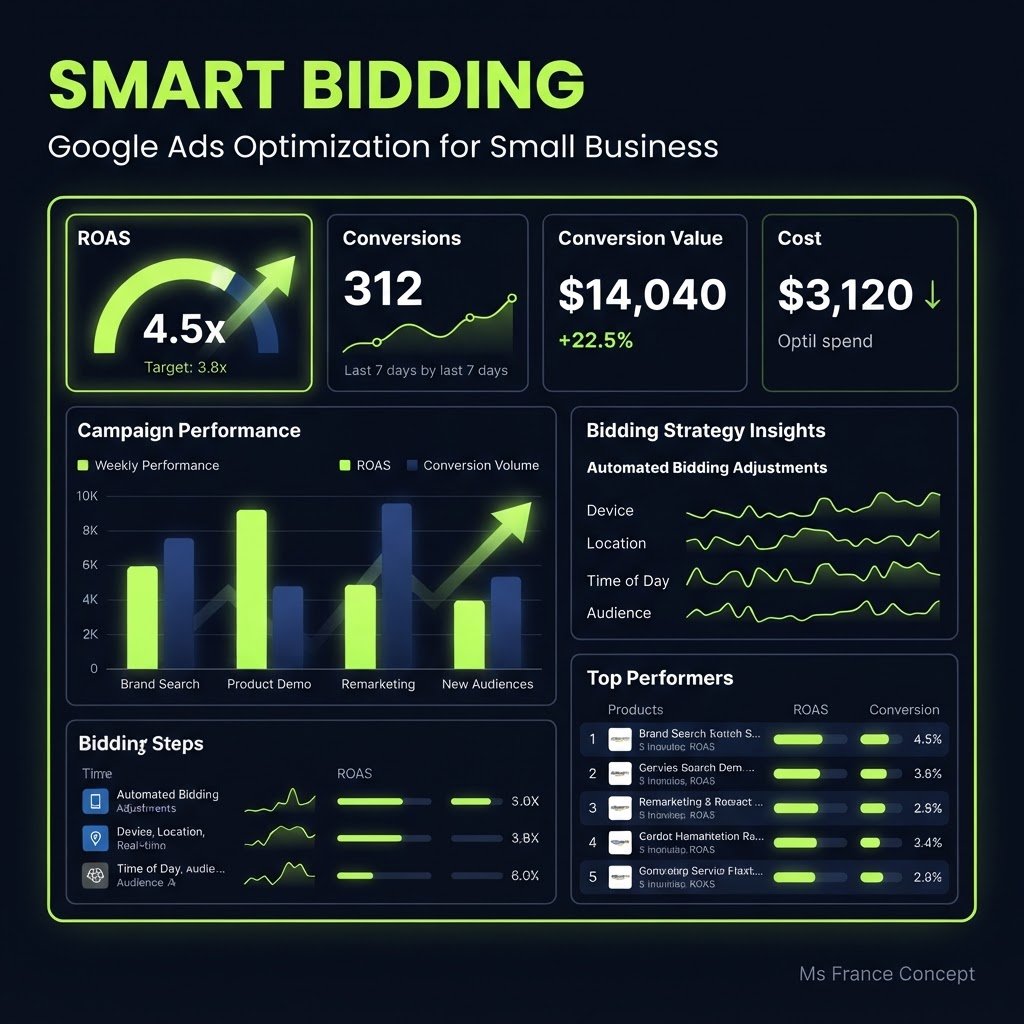
Smart Bidding — Google's automated bidding strategies based on machine learning — is presented as the miracle solution. But between theory and practice, there is a world of difference that few advertisers truly master.
Why it’s more complex than it seems
Smart Bidding is not just about clicking a button to 'Automatically optimise'. Several strategies coexist: Maximise conversions, Target CPA (target cost per acquisition), Target ROAS (target return on ad spend), Maximise conversion value.Each one addresses a specific business objective and requires different technical prerequisites: sufficient conversion volume, quality tracking, appropriate conversion window, exclusion of bad traffic.
Setting up a Smart Bidding strategy without preparation is like handing the wheel to an autopilot without having programmed the destination. The algorithm will optimise — but optimise what, and towards where? Without reliable conversion data, without properly reported conversion events, without excluding irrelevant queries, automation simply accelerates waste.
The signals that Google uses in machine learning — device, location, time, search query, browsing behaviour — are numerous. But some crucial signals for a local SME (specific purchase intent, business seasonality, immediate local competition) are not natively taken into account by the algorithm. This is where human expertise makes all the difference.
The consequences of doing nothing
Continuing to manage your bids manually in 2026 means accepting several cumulative penalties:
- Structural cost increase : advertisers using Smart Bidding benefit from real-time bidding signals that manual management cannot process. Your automated competitors pay less for the same click.
- Loss of share of voice : in the event of a demand spike (season, local event), manual bids do not adjust quickly enough. You disappear from the results at the worst moment.
- Budget exhaustion : without optimisation, the daily budget is consumed in the morning by unqualified clicks. In the afternoon — often the peak conversion time — your ads no longer appear.
- Blind decision-making : without rigorous conversion tracking, it is impossible to know which keyword is actually generating customers. You optimise for clicks, not for revenue.
What a professional does
A certified Google Ads specialist does not simply activate an automatic strategy. They start with a comprehensive account audit : campaign structure, conversion history, tracking quality, exclusion of bad queries, audience adjustments. They ensure that the data feeding the algorithm is reliable, complete, and relevant.
Next comes the choice of the strategy suited to your business, your volume, and your objective — generating calls, forms, in-store visits. The setup includes bid adjustments by device, geographical area, time of day, and exclusions of unprofitable terms. Monitoring does not stop at launch: a Smart Bidding account requires regular observation, A/B testing, and recalibrations based on actual performance.
Each case is unique. A personalised diagnosis allows us to identify the right approach in just a few minutes. Our Google Ads experts can evaluate your current setup for free and identify the most costly gaps.
Case study: a craftsman who doubled his ROI in 3 months
An electrician in Sète was spending €1,200/month on Google Ads with manual bids. Result: an average of 8 clicks/day, 2-3 calls per week, cost per acquisition of €180. An audit revealed faulty tracking, overly broad keywords, and no geographical adjustments.
After a complete restructuring and a migration to a tailored Smart Bidding strategy, with corrected tracking and precise exclusions, the results spoke for themselves: cost per acquisition halved (90€), 5-6 qualified calls per week, and a doubled advertising ROI in 3 months. The monthly budget did not increase — only the strategy changed. To learn more about this type of transformation, check out our dedicated resources.
Don't let Google Ads drain your budget
Smart Bidding is not a magic solution that can be activated with a single click. It is a powerful tool that requires expert configuration, reliable data, and regular monitoring. SMEs that venture into this alone often end up paying for the learning curve — sometimes several thousand euros — before giving up or calling in a professional.
Our team deals with this type of issue daily — contact us for a free audit. We analyse your Google Ads account, identify wastage, and establish a quantified action plan. Book your diagnosis or call us directly.
📞 04 65 84 00 27 · 📅 Make an appointment (30 min, free)
— The Communication Service – MS France Concept
Does this topic concern your site? We will review your situation and tell you what to correct, without jargon.